
Discover how intelligent search monitoring transforms SEO from guesswork into data-driven strategy, helping businesses stay competitive in an ever-changing digital landscape.
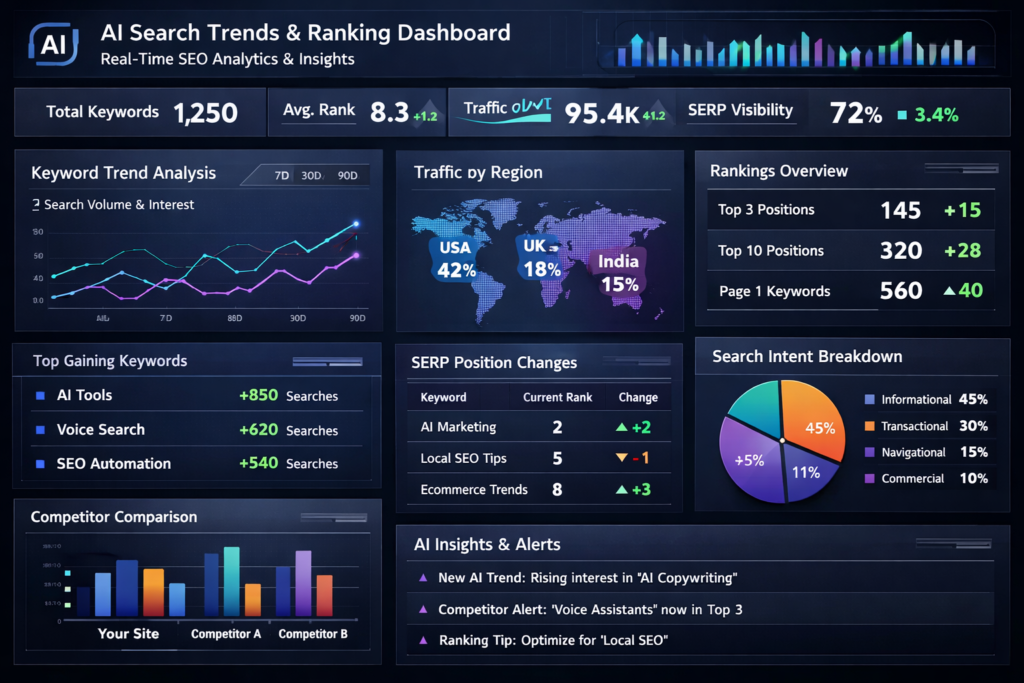
The Challenge: Why Traditional SEO Monitoring Falls Short
Search Engine Optimization has always been competitive. Ten years ago, keyword research and backlink building were enough to rank. Today? The landscape has fundamentally shifted. Search algorithms have become exponentially more sophisticated, and what worked six months ago may not work today.
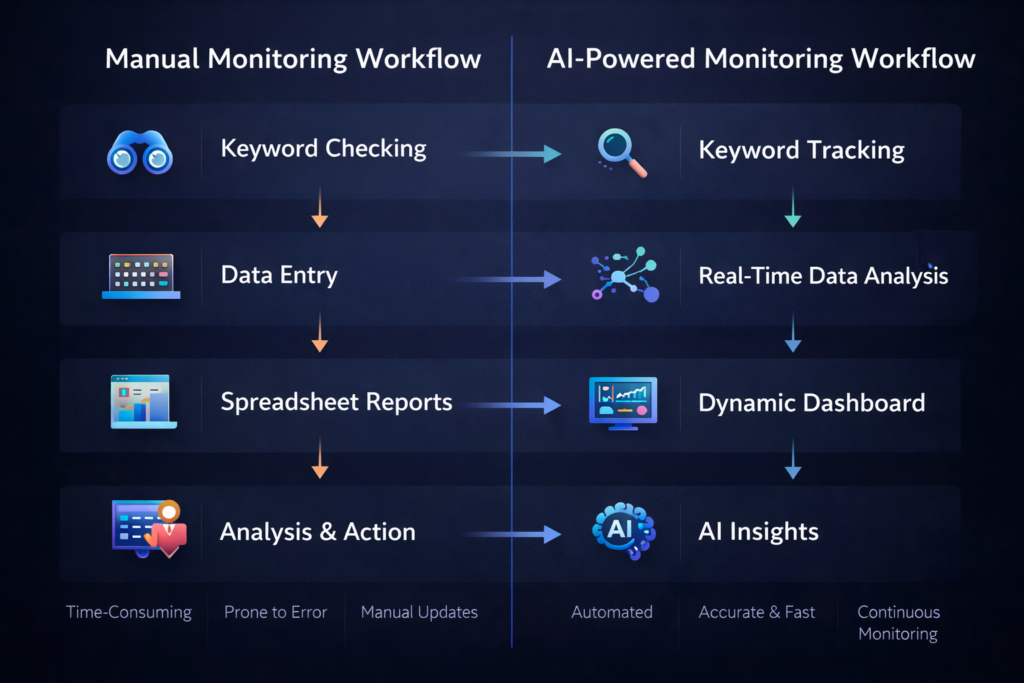
Most businesses still rely on manual SEO monitoring—checking rankings weekly, analyzing competitor sites sporadically, and reacting to drops in traffic. The problem? By the time you notice a 10% drop in organic traffic, you’ve already lost potential customers. And without real-time insights, you’re making decisions based on incomplete data.
This is where AI-powered search monitoring changes the game. Instead of reacting to changes, you can predict and prevent them.
What Is an AI Search Monitoring Platform?
An AI search monitoring platform is software that uses machine learning and natural language processing to continuously track keyword rankings, competitor strategies, search intent shifts, and content performance across search engines—usually Google, but also Bing and emerging platforms.
Unlike basic ranking tools that simply report, “you rank #5 for this keyword,” AI platforms:
- Predict future trends by analyzing historical data patterns and seasonal shifts
- Detect anomalies the moment search algorithms update, alerting you before competitors
- Analyze competitor strategies by reverse-engineering their content and backlink approaches
- Identify search intent changes by understanding semantic relationships and user behavior patterns
- Recommend actions with data-backed optimization suggestions
Real-life example: A fitness brand noticed their “best home workouts” content ranking at #3. A traditional tool would just report that. An AI platform detected that Google’s algorithm had shifted to prioritize video content over text and recommended creating a video version. After implementing these changes, the brand moved to #1 in three weeks.
Five Ways AI Search Monitoring Improves Your SEO Strategy
1. Real-Time Competitive Intelligence
Your competitors are changing their strategies right now. An AI platform shows you exactly what they’re doing: which keywords they’re targeting, what content they’ve published this week, where they’re getting backlinks, and what’s driving their traffic growth.
This isn’t espionage—it’s all public data. AI just processes it at scale and at speed no human analyst could match. You identify opportunities before competitors do.
2. Predictive Keyword Opportunity Discovery
AI doesn’t just tell you what keywords people are searching now. It predicts which keywords will explode in search volume in the next 3-6 months. This means you can create content around emerging topics before competitors realize there’s demand.
Imagine being the first to publish comprehensive content on a topic just as search volume spikes. That’s first-mover advantage, powered by AI.
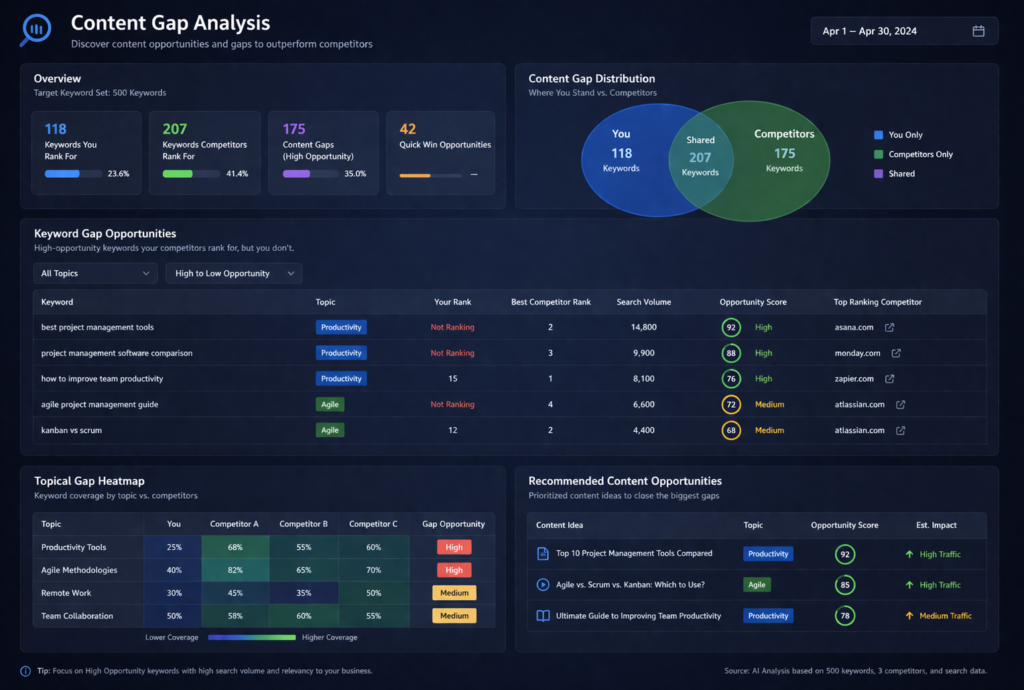
3. Content Gap Analysis at Scale
Which topics does your website cover? Which topics are competitors ranking for, but you’re not? Manual gap analysis takes weeks. An AI platform analyzes thousands of competitors simultaneously and instantly shows you the white space.
4. Algorithm Update Impact Assessment
Google releases updates regularly. When they do, your rankings often fluctuate. Traditional tools leave you guessing: “Did my rankings change because of the algorithm update, or because of my content changes?”
AI platforms track the exact moment updates roll out, analyze their impact across your niche, and tell you precisely which pages were affected and why. You adjust your strategy with certainty, not guesses.
5. Search Intent Optimization
Modern search is all about understanding user intent. Someone searching “best CRM for sales teams” has different intent than someone searching “how to use CRM software.” AI platforms analyze search results for each keyword and automatically classify intent, helping you create content that matches what Google wants to rank.
✓ Key Takeaway
AI search monitoring transforms SEO from a reactive, manual process into a proactive, data-driven strategy. You move faster, smarter, and with higher confidence.
How to Choose and Implement an AI Search Monitoring Platform
Not all AI search monitoring tools are created equal. Here’s what to look for:
- Real-time tracking: Updates should happen daily, not weekly
- Competitor analysis depth: Can it track unlimited competitors across multiple niches?
- Search intent classification: Does it categorize keywords by informational, navigational, and transactional intent?
- Actionable recommendations: Does it just report data, or does it tell you what to do next?
- Integration capabilities: Can it connect to your existing tools (Google Analytics, CMS, etc.)?
Implementation tip: Start small. Choose 3 to 5 high-priority keywords and monitor them closely for two weeks. Get familiar with the platform’s interface, understand how its recommendations translate to results, then expand to your full keyword portfolio.
The Results: What You Can Realistically Expect
Organizations using AI search monitoring typically see:
- 20-35% faster identification of ranking opportunities and competitive threats
- 30-50% improvement in content relevance through better search intent alignment
- 2-3 month acceleration in ranking improvements compared to manual SEO strategies
- 5-10x faster response to algorithm updates with minimal ranking loss
Results vary by industry, competition level, and how thoroughly you implement recommendations. But the pattern is consistent: AI-driven SEO outperforms manual optimization.
The Future of SEO Is Intelligent, Not Just Optimized
SEO in 2026 is a game of speed and intelligence. The businesses winning are those using AI to predict changes, not just react to them. They’re analyzing competitor moves at scale, discovering opportunities weeks before competitors realize they exist, and aligning their content with shifting search intent automatically.
An AI search monitoring platform isn’t a luxury anymore—it’s becoming a necessity. Whether you’re a solopreneur or managing a large content team, the ROI is clear: spend a few hours learning the platform, save dozens of hours on manual analysis, and watch your organic traffic compound over time.
The question isn’t whether AI can improve your SEO. It’s whether you can afford to compete without it.